
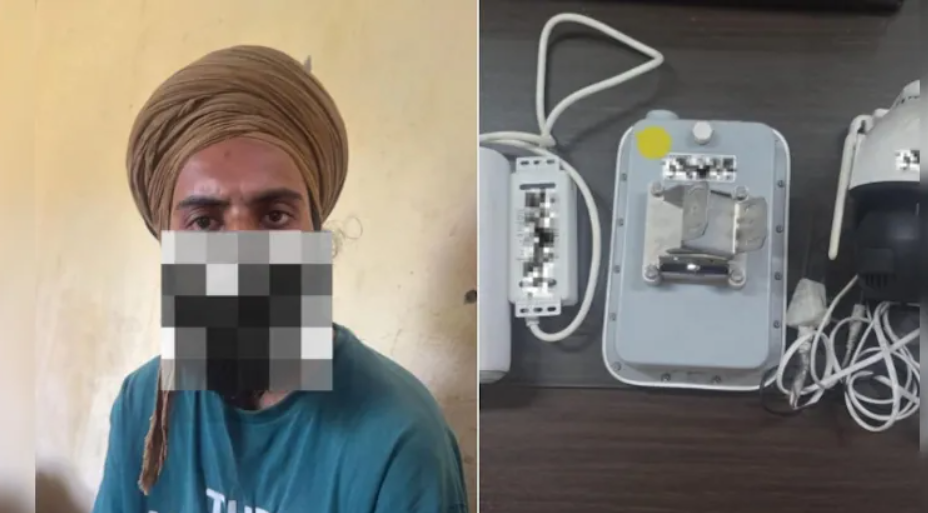
A major espionage network with alleged links to Pakistan has been uncovered in Punjab after police arrested a man accused of monitoring and sharing sensitive information about Indian Army and paramilitary force movements.
The accused, identified as Baljit Singh alias Bittu, is a resident of Chakk Dhariwal village in Pathankot district. According to investigators, he installed an internet-enabled CCTV camera at a shop near a bridge along the Pathankot-Jammu stretch of National Highway-44. The camera was allegedly used to track the movement of military convoys and security personnel traveling through the strategic route.
Police officials stated that the surveillance footage was transmitted electronically to handlers based in Pakistan and other foreign locations. During interrogation, Baljit Singh reportedly admitted that he had installed the camera in January under instructions received from an unidentified individual operating from Dubai. Authorities believe he was paid around ₹40,000 for setting up and maintaining the surveillance system.
A CCTV camera and a Wi-Fi router were recovered from his possession during the investigation. The operation was launched after intelligence agencies alerted local police about suspicious activities near the highway. Following the tip-off, the Sujanpur Police registered a case against four individuals, including Baljit Singh.
The other accused have been identified as Vikramjit Singh alias Vikka, Balwinder Singh alias Vicky, and Taranpreet Singh alias Tannu. Officials allege that the group was involved in activities that posed a threat to national security. Efforts are currently underway to arrest the remaining suspects and determine the full extent of the network’s operations.
Investigators are also examining possible cross-border connections, funding sources, and communication channels used by the accused. A detailed report has been submitted to senior authorities, and multiple agencies have joined the probe.
The latest arrest comes just weeks after Punjab Police dismantled two separate espionage modules allegedly backed by Pakistan’s Inter-Services Intelligence (ISI). In those cases, operatives were found using advanced Chinese-made solar-powered CCTV cameras capable of transmitting live footage from sensitive military locations directly to handlers across the border.
Police said these cameras were strategically installed near defense establishments and military zones. Their solar-powered design and 4G connectivity allowed them to function without traditional power sources, making them difficult to detect.
In one operation, authorities arrested a suspect from Ferozepur and recovered a CCTV camera, solar panel, and SIM card. In another raid, police seized surveillance equipment and mobile phones linked to foreign handlers. Investigators also discovered evidence suggesting that Pakistani operatives had provided financial support for the installation of surveillance devices.
Officials believe the use of modern surveillance technology represents an evolving threat to national security. Security agencies are now intensifying monitoring efforts across border states to prevent similar espionage activities.
The investigation remains ongoing, and authorities are working to uncover the complete network behind the operation. Further arrests are expected as police continue to trace the international links and funding channels associated with the alleged spy ring.