
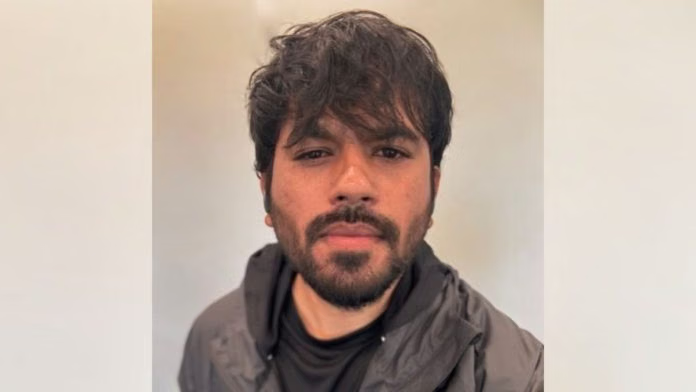
The founder of the rapidly growing online movement known as the Cockroach Janta Party (CJP), Abhijeet Dipke, has become the target of caste-based attacks on social media after publicly identifying himself as a Dalit. The incident has sparked widespread debate about caste discrimination, online harassment, and the role of social media in political discussions.
Dipke, a 30-year-old public relations student studying at Boston University in the United States, launched the Cockroach Janta Party as a satirical response to comments that triggered a major online conversation about unemployment and youth issues in India. What began as a humorous social media campaign soon evolved into a large digital movement attracting millions of followers and supporters.
The movement gained momentum after Dipke encouraged young people to embrace the label “cockroach” as a symbol of resistance and frustration. The campaign quickly resonated with a large section of India’s youth, many of whom expressed dissatisfaction with traditional political parties and existing political narratives. Within days, the Cockroach Janta Party’s social media presence exploded, attracting millions of followers on Instagram and generating significant engagement across multiple platforms.
As the movement continued to grow, Dipke introduced a satirical manifesto and launched various online campaigns aimed at encouraging political participation among young people. The initiative received attention from several public figures and political leaders, helping it gain even greater visibility.
However, alongside the support, questions were also raised about the movement’s position on issues such as social justice, caste discrimination, and reservation policies. During an online discussion, a social media user questioned why the movement had not clearly stated its views on Dalit issues and affirmative action.
Responding to the query, Dipke revealed that he himself belongs to the Dalit community. He posted a brief message stating that he was a Dalit and suggested that this fact should answer questions regarding his understanding of social justice concerns.
Shortly after his statement, several users on social media began posting comments that critics described as casteist and discriminatory. Some individuals questioned his credibility, while others made remarks targeting his caste identity. Screenshots of these comments quickly circulated online, drawing criticism from many users who condemned the attacks.
Supporters of Dipke argued that the trolling highlighted the persistence of caste prejudice in online spaces. Many social media users came forward to defend him, emphasizing that political discussions should focus on ideas and policies rather than personal backgrounds or caste identities.
Despite the controversy, Dipke has continued to focus on expanding the movement. According to his previous statements, the Cockroach Janta Party was initially intended as satire but has gradually evolved into a platform for civic engagement. He believes that many young Indians feel disconnected from both the government and traditional opposition parties and are searching for new ways to participate in public life.
Dipke’s long-term vision involves building a digital community that encourages political awareness among younger generations. Rather than functioning as a conventional political party, he hopes the platform can motivate people to become more active citizens. His plans include promoting transparency, encouraging the use of tools such as Right to Information (RTI) applications, and helping young people hold governments accountable.
The episode has once again highlighted how social media can serve as both a platform for democratic participation and a space where discrimination and hostility can emerge. As the Cockroach Janta Party continues to attract attention, debates surrounding caste, youth politics, and online activism are likely to remain in the spotlight.