
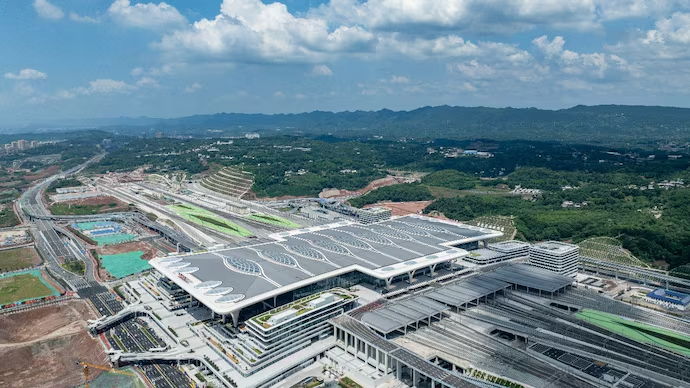
China has once again demonstrated its engineering and infrastructure capabilities with the completion of Chongqing East Railway Station, officially recognized as the world’s largest railway station by floor area. What makes the achievement even more remarkable is that the massive transportation hub was completed in just 38 months, a timeline that has amazed infrastructure experts around the world. The project has gained global attention after a video showcasing its construction journey was widely shared online.
Located in Chongqing, one of China’s largest and fastest-growing cities, the station covers an enormous 1.22 million square meters. The city itself has a unique history. While Chongqing is an ancient settlement with a history stretching back thousands of years, its rapid transformation began during the 1960s under Mao Zedong’s Third Front Campaign. This national strategy focused on developing China’s inland regions by investing heavily in industries, transportation networks, manufacturing, and infrastructure.
Today, Chongqing is a major economic powerhouse with an annual economy worth hundreds of billions of dollars. The city plays a crucial role in manufacturing, electronics, automobiles, logistics, and international trade. Because of its strategic location in western China, efficient transportation links are essential for connecting businesses and residents to the rest of the country.
To meet rising transportation demands, Chinese authorities launched the Chongqing East Railway Station project in 2022. The station was designed as a multi-modal transportation hub that integrates high-speed rail services, conventional railways, buses, taxis, long-distance coaches, and metro connections. It features 15 platforms and 29 railway tracks and is capable of handling up to 16,000 passengers every hour during peak operations.
One of the most fascinating aspects of the project was the extensive use of advanced robotics during construction. Chinese media described the effort as a “robot revolution,” as a large number of intelligent machines were deployed to accelerate work and improve accuracy. Instead of relying solely on traditional labor-intensive methods, engineers integrated artificial intelligence, automation, and robotics throughout the construction process.
Laser-guided screed robots equipped with LiDAR technology, artificial intelligence systems, and 5G connectivity were used to level concrete surfaces with millimeter-level precision. These robots reportedly completed tasks three times faster than conventional methods while significantly reducing labor requirements. Glass installation robots handled massive panels weighing hundreds of kilograms, improving safety and efficiency. Specialized welding robots worked continuously, while autonomous patrol robots monitored construction activities around the clock.
According to project officials, the use of robotics nearly cut labor costs in half, tripled work efficiency, and reduced workplace accidents by approximately 90 percent. This technological approach proved particularly valuable because construction took place in difficult terrain and extreme summer temperatures that often exceeded 40 degrees Celsius.
The station now serves as a critical component of China’s vast high-speed rail network. Travelers can quickly access major cities such as Chengdu, Wuhan, Xi’an, Shanghai, Guangzhou, and Beijing through direct rail connections, dramatically reducing travel times and strengthening regional economic integration.
Beyond being a transportation facility, Chongqing East Railway Station symbolizes China’s broader strategy of combining technology, infrastructure investment, and long-term planning to execute mega-projects at an extraordinary scale. The station stands as a powerful example of how robotics and automation are reshaping the future of construction and transportation worldwide.