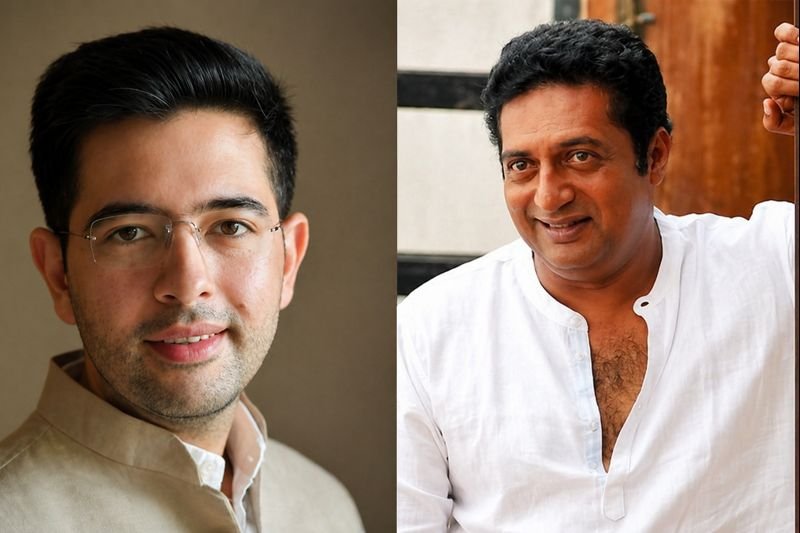
Actor Prakash Raj has once again found himself at the center of a social media storm after sharing a sarcastic meme targeting politician Raghav Chadha. The post, which quickly went viral, has triggered a wide range of reactions online, with users divided over whether the actor’s comment was justified satire or an unnecessary personal attack.
The controversy comes shortly after Raghav Chadha’s high-profile exit from the Aam Aadmi Party (AAP) and his decision to join the Bharatiya Janata Party (BJP). This political move has already generated significant discussion, as Chadha was considered one of the prominent young leaders of AAP and had played an important role in the party’s growth over the years.
Amid this backdrop, Prakash Raj took to social media platform X (formerly Twitter) and shared a meme that many interpreted as a direct dig at Chadha’s decision. The meme used a sarcastic analogy, suggesting that someone leaving one institution citing a loss of values and then joining another controversial entity would appear contradictory. While the meme did not explicitly name Chadha, the timing and context made the target of the satire quite clear.
Prakash Raj is known for his outspoken views on political and social issues, often using humor and satire to express his opinions. In this instance, his post seemed to question the ideological consistency behind Chadha’s switch from one political party to another. The use of humor, however, did not prevent the message from being perceived as sharp criticism.
The reaction on social media was immediate and sharply divided. A section of users supported Raj, praising him for speaking out and using satire to highlight what they saw as contradictions in political behavior. They argued that public figures should be open to criticism, especially when making significant political decisions that affect public perception.
On the other hand, many users criticized the actor’s post, calling it inappropriate and biased. Some felt that comparing a political move to such an extreme analogy crossed the line and was in poor taste. Others defended Raghav Chadha, stating that changing political affiliations is a legitimate part of democratic systems and should not be ridiculed in this manner.
Raghav Chadha’s departure from AAP itself has been a subject of intense debate. Having been one of the party’s younger and more visible leaders, his exit has raised questions about internal differences within the party. His move to the BJP is being seen by some as a strategic shift, while others view it as a departure from the values he once represented.
This incident highlights the growing role of social media in shaping political narratives in India. Platforms like X have become spaces where not only politicians but also actors, influencers, and public figures actively participate in political discourse. Memes, in particular, have emerged as a powerful tool for commentary—often blending humor with sharp political messaging.
the line between satire and controversy is often thin. While memes can make complex issues more relatable, they can also intensify divisions and spark heated debates, as seen in this case. The rapid spread of such content ensures that discussions move quickly from individual opinions to nationwide conversations.
As reactions continue to pour in, the episode reflects the evolving relationship between entertainment, politics, and digital media. It also raises broader questions about the responsibilities of public figures when commenting on sensitive political matters. Whether seen as humor or criticism, Prakash Raj’s meme has once again demonstrated how a single post can ignite widespread debate in today’s connected world