
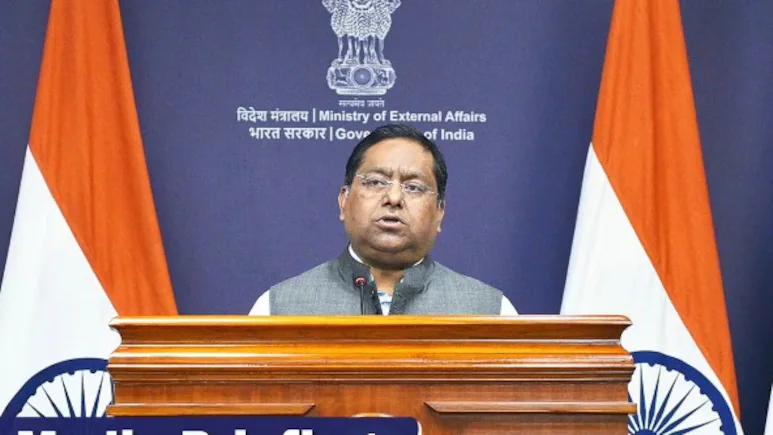
India has sharply responded to the recent joint statement issued by China and Pakistan that made references to Jammu and Kashmir and Ladakh. The Ministry of External Affairs (MEA) stated that the comments made by the two countries were completely unacceptable and reiterated that Jammu and Kashmir and Ladakh are integral and inseparable parts of India.
The strong reaction came after Pakistan and China released a joint statement during Pakistani Prime Minister Shehbaz Sharif’s visit to Beijing. In the statement, Pakistan reportedly briefed China on developments related to Jammu and Kashmir, while China referred to the issue as a historical dispute that should be resolved peacefully. India immediately objected to these remarks and asserted that no foreign country has the authority to comment on matters related to its sovereign territory.
MEA spokesperson Randhir Jaiswal emphasized that India’s position on Jammu and Kashmir and Ladakh has remained unchanged for decades. He stated that the Union Territories “have been, are, and will always remain” an inseparable part of India. The government also stressed that any attempt by other countries to question India’s territorial integrity would be firmly rejected.
India additionally raised objections to references concerning the China-Pakistan Economic Corridor (CPEC). Several infrastructure and development projects under the CPEC initiative pass through Pakistan-occupied Kashmir (PoK), a region India considers part of its sovereign territory illegally occupied by Pakistan. New Delhi once again reiterated its opposition to such projects, arguing that they violate India’s sovereignty and territorial integrity.
According to the Foreign Ministry, India has repeatedly conveyed its concerns to both Islamabad and Beijing regarding activities taking place in PoK. Officials stated that India does not recognize Pakistan’s control over those regions and therefore opposes any international project or cooperation that appears to legitimize such occupation.
The government also criticized references in the China-Pakistan statement related to “trans-boundary water resources cooperation.” India pointed out that China and Pakistan do not share a direct boundary in the area being discussed, making such claims questionable from India’s perspective. Officials stressed that New Delhi has never accepted the 1963 boundary agreement signed between Pakistan and China, under which Pakistan ceded territory in the Shaksgam Valley to China. India considers that agreement invalid because the territory involved belongs to India.
The diplomatic exchange reflects the continuing tensions between India, China, and Pakistan over border disputes and regional security issues. Jammu and Kashmir has remained one of the most sensitive geopolitical matters in South Asia for decades. India has consistently maintained that the issue is strictly internal and that any disputes with Pakistan must be resolved bilaterally without external interference.
Political analysts believe India’s sharp response was intended not only to reject the recent statement but also to send a broader diplomatic message regarding sovereignty and territorial claims. The government appears determined to firmly counter any international narrative that questions India’s position on Jammu and Kashmir or Ladakh.
The latest developments come at a time when relations between India and both neighboring countries remain strained due to border tensions, security concerns, and strategic competition in the region. As geopolitical dynamics continue to evolve in Asia, issues involving territorial claims and regional alliances are expected to remain at the center of diplomatic discussions.
For now, India has made its stand clear: Jammu and Kashmir and Ladakh are non-negotiable parts of the country, and any external remarks challenging that position will continue to face strong opposition from New Delhi.