
A former Meta employee has attracted widespread attention online after revealing that she voluntarily requested to be included in the company’s latest round of layoffs. Her decision has reignited conversations about the growing influence of artificial intelligence in the workplace and how rapidly changing corporate priorities are reshaping career choices across the technology industry.
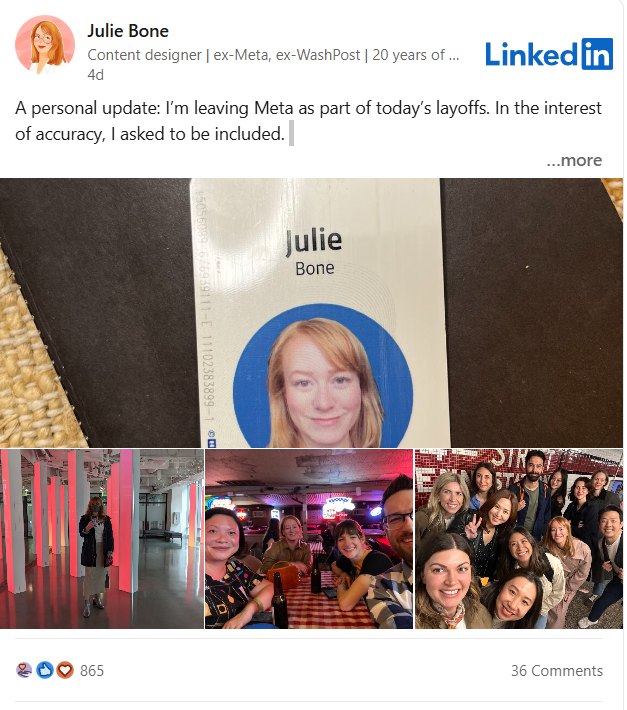
Julie Bone, who worked as a content designer at Meta Platforms and contributed to projects related to Facebook, recently shared details of her departure in a public LinkedIn post. After completing six years with the company, she decided it was time to move on, explaining that the organization’s long-term vision no longer matched her own professional aspirations and personal goals.
According to Bone, her decision was not made suddenly. Instead, she had spent considerable time reflecting on her future and evaluating whether her career objectives still aligned with Meta’s evolving direction. She noted that while she appreciated many aspects of her experience at the company, she increasingly felt that her interests were heading in a different direction from the one Meta was pursuing.
One of the factors influencing her decision was the company’s growing emphasis on artificial intelligence. Like many major technology firms, Meta has been investing heavily in AI development and integrating AI-powered tools across its operations. Employees are increasingly expected to use AI technologies for tasks such as idea generation, product prototyping, workflow automation, data analysis, and solving technical challenges.
Bone described how AI-related skills had become a significant part of daily work culture. Teams were encouraged to adopt new tools and adapt to emerging workflows designed to improve efficiency and productivity. While she acknowledged the value of these technologies, she also suggested that simply learning AI tools may not guarantee long-term career stability in an industry undergoing rapid transformation.
In her statement, Bone said that part of her motivation for volunteering to leave was personal. She believed the timing was right for a career transition and hoped that stepping aside might create opportunities for other employees who wished to remain at the company. She admitted she was uncertain whether her request actually influenced internal layoff decisions, humorously noting that she may have already been on the list before making the request.
Her comments quickly gained traction online, prompting discussions about job security in the age of artificial intelligence. Many professionals shared similar concerns about how automation and AI-driven workflows are changing expectations in workplaces around the world. Others viewed her decision as an example of prioritizing personal values and career satisfaction over remaining in a role that no longer felt aligned with her interests.
Despite choosing to leave, Bone spoke positively about her time at Meta and expressed gratitude toward her colleagues. She highlighted her work involving brand voice development, content strategy, and localization efforts as some of the most rewarding experiences of her career. These projects allowed her to help shape communication strategies for diverse global audiences.
Looking ahead, Bone plans to take a short break before exploring new opportunities. She said she hopes to join organizations where creativity, strong communication skills, cultural understanding, and editorial judgment continue to play an important role alongside technological innovation. Her story reflects a broader trend as professionals across industries reconsider their career paths amid the rapid rise of artificial intelligence and evolving workplace expectations.