
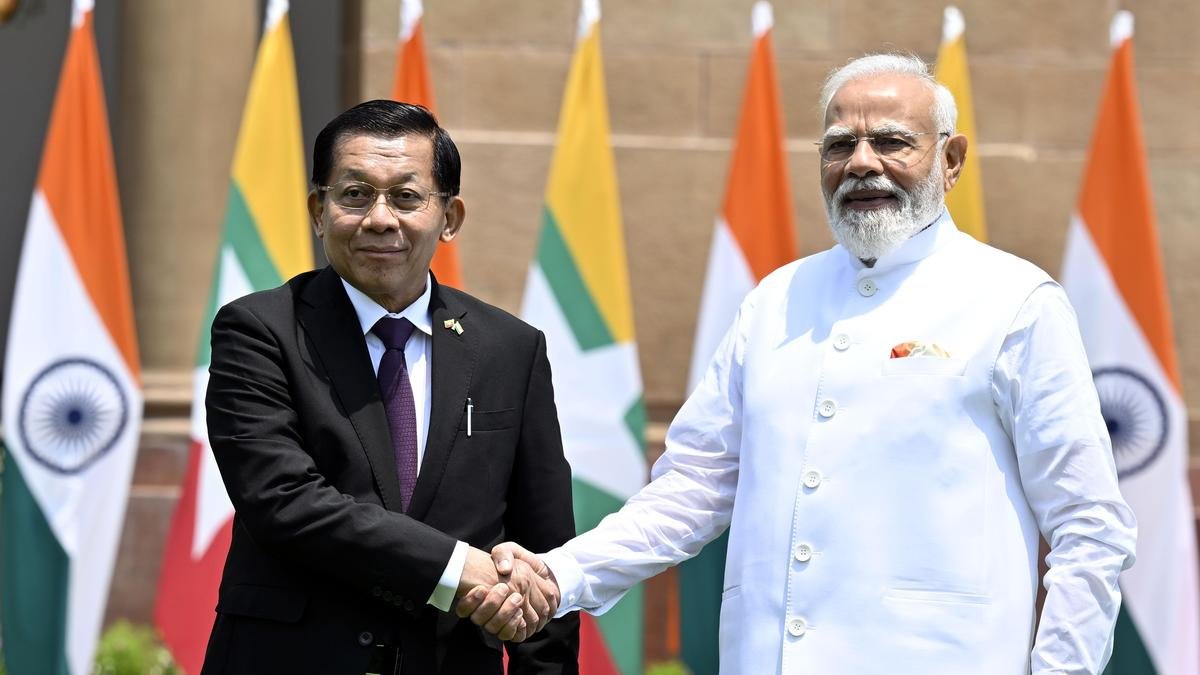
India and Myanmar have reaffirmed their commitment to strengthening bilateral relations, with both countries expressing a strong desire to expand cooperation across multiple sectors, including trade, investment, energy, connectivity, education, healthcare, and regional security. The renewed focus on collaboration emerged during high-level talks between Indian Prime Minister Narendra Modi and Myanmar President U Min Aung Hlaing in New Delhi.
The discussions covered a wide range of issues that are central to the relationship between the two neighboring nations. Both leaders reviewed ongoing cooperation in economic development, border security, infrastructure projects, cultural exchanges, and regional stability. They also explored new opportunities to deepen engagement in areas that could contribute to long-term growth and prosperity for both countries.
One of the major outcomes of the meeting was the emphasis placed on enhancing economic cooperation. India and Myanmar agreed to work more closely in promoting trade and investment opportunities. Officials from both sides highlighted the importance of creating a favorable environment for businesses and encouraging stronger commercial ties between the two nations.
Energy cooperation also featured prominently in the discussions. With global demand for critical minerals and rare earth resources increasing rapidly, both countries acknowledged the importance of exploring partnerships in these strategic sectors. Government representatives and business entities from India and Myanmar are expected to continue discussions aimed at identifying areas for mutual benefit and future investment.
Connectivity was another key theme of the bilateral talks. Both leaders underlined the importance of improving transportation links and people-to-people exchanges. Special attention was given to the Kaladan Multi-Modal Transit Transport Project, a major infrastructure initiative designed to improve connectivity between India’s northeastern states and Myanmar. The project is considered a crucial component of India’s broader regional engagement strategy and is expected to enhance trade routes and economic integration.
Prime Minister Modi reiterated India’s support for Myanmar’s sovereignty and territorial integrity. Security cooperation was also discussed extensively, with both sides emphasizing the importance of preventing their territories from being used for activities that could threaten the security interests of either country. Myanmar assured India that its territory would not be allowed to serve as a base for activities detrimental to India’s national security.
Myanmar holds significant strategic importance for India due to its geographical location. Sharing a border of over 1,600 kilometers with India, Myanmar serves as a vital bridge between South Asia and Southeast Asia. The country plays an important role in India’s “Neighbourhood First,” “Act East,” and Indo-Pacific policies, making bilateral cooperation a key pillar of India’s regional diplomatic strategy.
The leaders also exchanged views on regional developments and ongoing peace efforts within Myanmar. Discussions included the importance of inclusive dialogue, stability, and democratic processes. India reaffirmed its long-standing position of supporting peace, reconciliation, and engagement among all stakeholders while respecting Myanmar’s internal affairs.
Current trade between India and Myanmar exceeds $2 billion annually, reflecting the growing economic relationship between the two countries. Both governments expressed optimism that continued collaboration in infrastructure, trade, investment, and strategic sectors would significantly increase this figure in the coming years.
The meeting highlighted the shared commitment of both nations to building a stronger and more comprehensive partnership. As regional dynamics continue to evolve, India and Myanmar appear determined to deepen cooperation and strengthen their strategic relationship for mutual development, stability, and prosperity.