
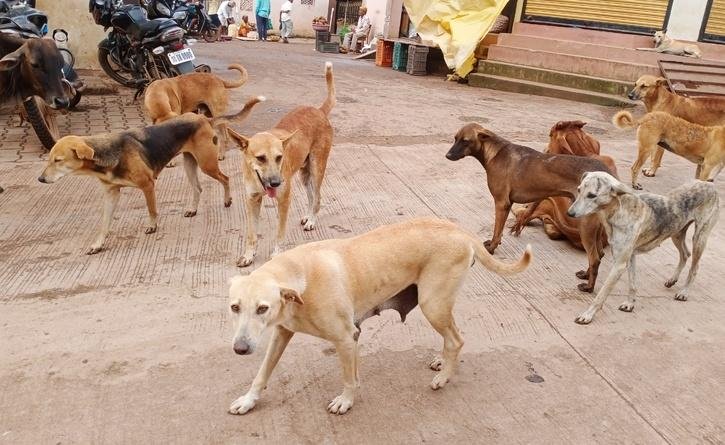
The Supreme Court on Tuesday strongly defended its earlier order regarding the removal of stray dogs from public spaces and refused to make any changes despite several petitions filed by animal lovers and NGOs. The court made it clear that public safety cannot be ignored, especially when incidents involving dog attacks are increasing across the country.
While hearing the matter, the top court highlighted the growing number of dog bite cases and stressed that citizens have a constitutional right to live without fear. According to the judges, the “right to live with dignity” also includes the right to move freely in public places without the danger of being attacked by stray dogs. The court said it could not overlook the harsh realities where children, elderly citizens, and even international travellers have become victims of dog attacks.
The Supreme Court also expressed disappointment over the poor implementation of the Animal Birth Control (ABC) programme, which was introduced in 2001 to control the stray dog population through sterilisation and vaccination. The judges observed that many states and local authorities failed to expand resources and infrastructure despite the growing dog population. Because of this lack of planning and execution, the objectives of the ABC framework have not been achieved even after many years.
The bench referred to alarming statistics presented during the hearing. In Rajasthan’s Sri Ganga Nagar alone, over 1,000 dog bite cases were reported within a single month. Several children reportedly suffered severe injuries, including facial mauling. Tamil Nadu too recorded nearly two lakh dog bite incidents within the first four months of the year. The court noted that these numbers show the seriousness of the issue and why authorities cannot remain passive spectators.
The judges warned state governments that failure to follow court directions would be treated seriously. The court said strict action, including contempt proceedings and disciplinary measures, could be initiated against officials who fail to comply. It also directed states, the Centre, and agencies like the National Highways Authority of India (NHAI) to submit compliance reports by November 17.
In one of its strongest remarks, the Supreme Court said that if such situations continue unchecked, society may slowly move towards a “survival of the fittest” system similar to Darwin’s theory of evolution. The judges stated that such a condition would be completely against the principles of constitutional democracy and the rule of law. The court emphasised that public spaces should be safe for everyone and that governments have a responsibility to protect citizens while also ensuring humane treatment of animals.