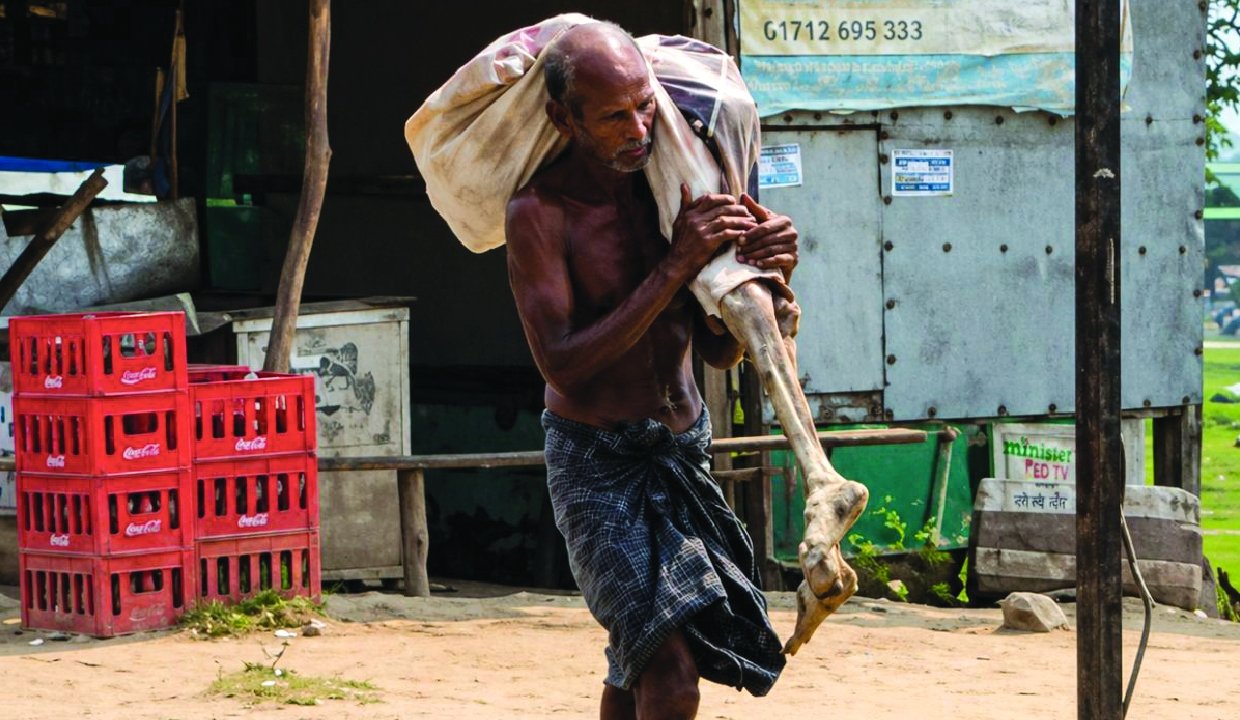
A shocking incident from Odisha’s Keonjhar district has triggered widespread outrage and highlighted serious gaps in rural banking procedures. A 52-year-old tribal man reportedly brought the skeletal remains of his deceased sister to a bank after repeated requests to withdraw money from her account were denied.
The incident took place at the Mallipashi branch of Odisha Gramya Bank in the Patna block, a tribal-dominated region. The man, identified as Jeetu Munda from Diananali village, had been attempting for several days to withdraw approximately ₹19,300 that his late sister, Kalra Munda, had deposited in her account before her death.
Kalra Munda had passed away on January 26 following a prolonged illness. After her death, Jeetu, who claimed to be her legal heir, approached the bank seeking to access the funds. However, bank officials reportedly refused his request, stating that he did not have sufficient documentation to prove her death or establish his eligibility to withdraw the money.
According to local sources, Kalra had lived with her brother for nearly three decades after losing her husband and child. The money in question was reportedly deposited after she sold an ox shortly before her passing, making it a significant amount for the family.
Frustrated by repeated rejections and unable to understand the formal procedures due to his illiteracy, Jeetu took an extreme step. He allegedly exhumed his sister’s remains from her burial site and carried the skeleton in a sack to the bank, located about three kilometres from his village, in an attempt to prove that she had indeed passed away.
The incident left bank staff and customers in shock. Police were immediately informed after the man arrived with the remains. Officials later stated that better communication from the bank could have prevented such a situation. Authorities noted that Jeetu was unaware of essential banking requirements, such as the need for a nominee or official death certificate.
Following the incident, the matter quickly gained attention at the state level. Political leaders criticised the handling of the situation, calling it not just a banking failure but a humanitarian issue. The opposition raised the matter with the Union Finance Ministry, demanding reforms in rural banking practices to make them more accessible and sensitive to the needs of underprivileged communities.
The district administration intervened promptly to resolve the issue. After verifying the details, officials facilitated the release of the funds to Jeetu Munda. He was handed ₹19,402 from his sister’s account and also received an additional ₹30,000 as financial assistance from the Red Cross fund.
Meanwhile, Odisha Chief Minister Mohan Charan Majhi ordered an inquiry into the incident to examine how the situation was handled and to identify lapses in the system. Authorities aim to ensure that similar incidents do not occur in the future.
This case has sparked a broader discussion about the challenges faced by rural and tribal populations in accessing banking services. It underscores the need for simplified procedures, better awareness, and more compassionate handling of cases involving vulnerable individuals.
The incident serves as a stark reminder that while financial inclusion has expanded in India, gaps still exist in ensuring that services are accessible and understandable for all sections of society.